
Introduction
Lies have always existed, and a common part of our daily interactions, whether it's telling someone they look great when they're having a bad day or pretending to enjoy a gift that we don't particularly like, to damn right criminal lies.
Studies have shown that individuals may tell anywhere from 1 to over 200 lies per day, and many are leaving their mark long after they’re first told!
But understanding the different types of lies can help you identify the type of deception and protect yourself, whether it's from being misled in personal relationships, falling victim to scams or fraud, or being influenced by misleading information.
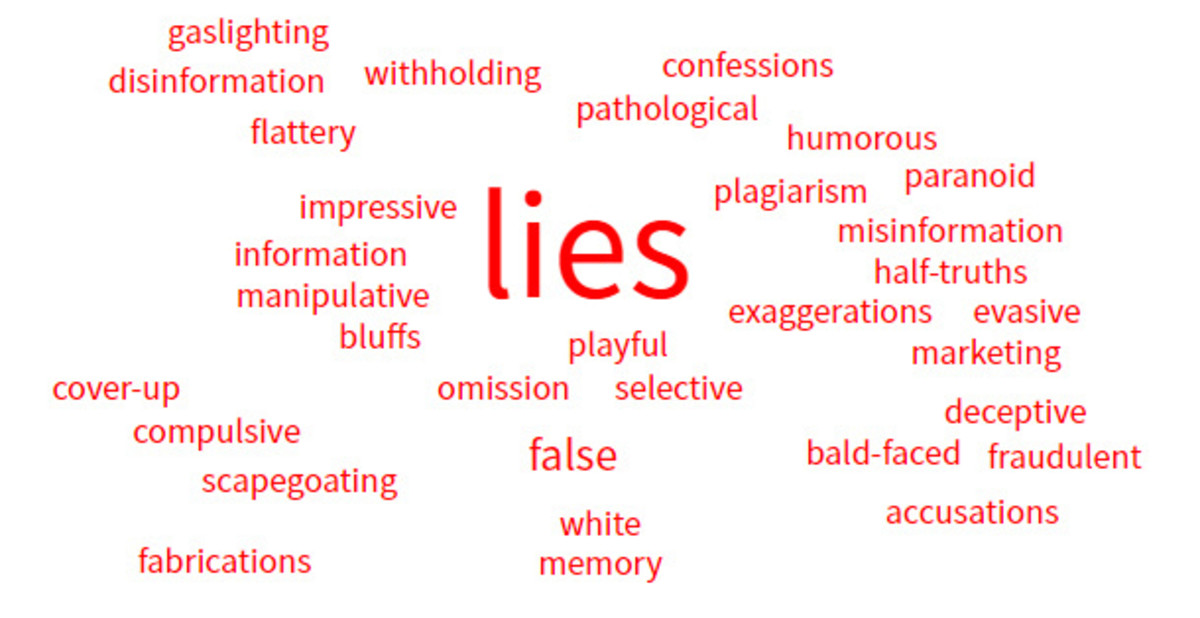
This article will explore 25 types of lies, ranging from small 'white lies' such as flattery and playful/humorous lies – to more serious ones like false accusations, aka BS, selective memory, and discuss the reasons behind them.
Table of Contents / Types of Lies
- Errors/Mistakes
- White lies
- Playful / Humorous Lies
- Exaggerations
- Flattery
- Half-Truths / Selective Memory
- Cover-Up Lies
- Evasive Lies
- False Accusations / Slander
- Bluffs
- Manipulative Lies
- Deceptive Marketing
- Scapegoating
- Lies Of Omission
- Withholding Information
- Bald-Faced Lies
- Misinformation and Disinformation / Propaganda
- Fabrications / Hoaxes
- Plagiarism
- False Confessions
- Impressive Lies
- Compulsive / Pathological Lies
- Paranoid Lies
- Fraudulent Lies / Perjury
- Gaslighting
- Summary - plus an update. Cheating, another example of lying. As well as Forgery.
- Video: The Science of Lying
These types of lies may share similarities with others, but each of the 25 types presented in the article has distinct characteristics that set them apart from the rest.
1 - Errors/Mistakes
When Mistakes Become Lies: Unintentional Deception.
People can unintentionally spread false information or stories, even when they believe they are true, which happens when individuals rely on unreliable sources. For instance, if someone shares a story they heard from someone without checking the facts, it can lead to the spread of misinformation.
Another way that people can unintentionally spread false information is by misremembering or misinterpreting events that they heard or saw, resulting in unintentional lies. When an incident occurs that requires investigation by the police, there may be multiple witnesses who see and observe different things due to their position and observations, leading to conflicting accounts of the event.
By being mindful of these potential pitfalls and avoiding the spread of unintentional lies (errors/mistakes), we can all help to sto this by checking the accuracy of any claims before passing them on to others and to be honest about what we know and what we don't know.
2 - White Lies
The Slippery Slope of White Lies: How Small Deceptions Can Lead to Big Problems.
White lies are a type of lie that people tell to avoid hurting someone's feelings or causing unnecessary harm. They are often considered harmless and necessary in certain situations, such as when a friend asks if they look good in an outfit, and you say yes to spare their feelings.
However, white lies can also have negative consequences, such as causing misunderstandings or eroding trust in relationships. Studies have shown that people's desire to maintain social harmony and avoid conflict can lead them to tell white lies. People may also tell white lies to manage their self-image or to avoid uncomfortable situations.
While white lies may seem harmless, be mindful of their potential consequences and consider whether telling the truth may be a better option in some situations.
3 - Playful / Humorous Lies
Fibs and Giggles: The Line Between Joking and Lying.
Playful or humorous lies are statements said in a social context to amuse or entertain others. The intention is not to be taken seriously, but to create a light-hearted atmosphere.
One example of a playful lie could be telling a friend that you won the lottery and then revealing that it was just a joke. Another example could be pretending to be a celebrity to get free drinks at a bar. These types of lies are usually harmless and told for fun.
However, even playful lies can have consequences. They can lead to misunderstandings, hurt feelings, and damage relationships if taken too far or not revealed as jokes promptly.
Some people may not find playful or humorous lies funny or entertaining but consider them annoying or disrespectful. So, know your audience and use your judgement when telling these lies.

4 - Exaggerations
Fudging the Facts: How Exaggeration Can Lead to Falsehoods.
Exaggerations are a falsehood in which people make statements or claims that are not entirely accurate or true. The purpose of exaggeration is often to make something appear more dramatic or significant than it is.
For instance, someone may exaggerate the size of a fish they caught or the number of people at a party they attended to gain attention and approval from others.
While exaggerations can make a story more engaging, be mindful of the line between harmless exaggeration and outright lying. Remember that when you make exaggerated claims, you risk damaging your credibility and trustworthiness with others. That being said, if the exaggeration is harmless and not putting anyone in danger, it may not necessarily be harmful to others.
For example, if someone exaggerates the amount of weight they can lift at the gym, it may not necessarily be harmful to others as long as they are not putting themselves or others in danger.
5 - Flattery
When Flattery Becomes Manipulation: The Dark Side of Compliments.
Flattery is a lie that people often use to make someone feel good or to gain favour. It involves giving excessive or insincere praise to someone to manipulate them into liking you or doing something for you.
For example, a coworker may flatter their boss by telling them they are the best boss they have ever had, even if they don't believe it. This flattery may be an attempt to gain a promotion or special treatment. Similarly, someone may flatter a romantic partner by telling them they are the most beautiful person in the world, even if they don't believe it. This flattery may be an attempt to win their partner's affection or cover up a mistake.
While flattery can sometimes be harmless, it can also be a form of lying and manipulation. Be aware of flattery and question whether it is sincere or an attempt to manipulate you.
6 - Half-Truths / Selective Memory
The Art of Deception: How Half-Truths and Selective Memory Can Mislead.
Half-truths and selective memory are common forms of deception that involve presenting incomplete or inaccurate information to others. While these tactics may not be as deceitful as bald-faced lies, they can still damage relationships and trust.
Half-truths involve telling only part of the story while leaving out important details or context to create a false impression and lead to misunderstandings or misinterpretations.
For example, A student may tell their teacher they couldn't complete their homework because of a family emergency but fail to reveal that it was a last-minute concert they decided to attend. A politician may say they created a certain number of jobs, but not mention that many are low-paying or part-time positions with no benefits.
Selective memory, on the other hand, involves intentionally recalling only certain aspects of a situation while ignoring others to downplay one's involvement in a challenging event or to emphasise one's role in a positive one.
For example, a person may remember all the times they helped a friend but conveniently forget when they were unreliable or didn't show up when needed. A witness in a trial may selectively remember certain details that support their version of events, while ignoring other details that contradict it.
People often use these tactics to avoid responsibility or manipulate a situation to their advantage. However, in the long run, such tactics can destroy trust and relationships, so being honest and transparent, even when uncomfortable, can help you build a reputation for integrity and trustworthiness.
Lies, lies, and an endless web of deceit.
7 - Cover-Up Lies
The Cover-Up Lie: When the Lie Becomes Worse Than the Truth.
Cover-up lies are deliberate attempts to hide or disguise the truth about a particular situation or event to protect oneself or others from the consequences of their actions. Cover-up lies can take many forms, including lying by omission, fabricating evidence, or providing a false alibi.
For example, a person may lie to the police about their whereabouts when a crime was committed, or lie about their knowledge of the crime to protect themselves or someone else.
Another example is when someone lies to conceal an affair from their partner by lying about where they were, who they were with, or what they were doing. In this case, the person is motivated to protect their relationship and prevent their partner from finding out about the affair.
Cover-up lies are often thought out and deliberate and can have serious consequences. While it may be tempting to tell a cover-up lie to avoid the consequences of one's actions, admitting one's mistakes and taking responsibility is ultimately the best way to move forward and rebuild trust.

8 - Evasive Lies
Dancing Around the Truth: The Art of Evasive Lies.
Evasive lies are a common form of dishonesty used in many settings. One common type of evasive lie is the 'white lie', a small falsehood told to avoid hurting someone's feelings or to make a situation more comfortable.
Another type of evasive lie is the playful or humorous lie used to avoid answering a question while providing some form of response. For example, a person who is asked if they have ever stolen something may say, "I'm not a thief," instead of directly answering the question. This evasive lie can be a way to avoid answering a question directly without causing offence or discomfort.
These lies can also be used in conjunction with other forms of dishonesty, such as half-truths or cover-up lies. For example, someone may use evasive language to avoid answering their involvement in a particular situation, while also leaving out key details that would reveal the truth.
It's worth noting that evasive lies can sometimes be confused with errors or mistakes. However, while errors and mistakes are unintentional, evasive lies are deliberate attempts to avoid telling the truth.
In conclusion, evasive lies can be used to avoid uncomfortable situations or to deflect from difficult questions, but they ultimately involve a deviation from the truth. While they may seem harmless, they can erode trust and damage relationships over time.
9 - False Accusations / Slander
The Slippery Slope of False Accusations: When Innocent People Are Punished.
False accusation lies involve making up false claims or accusations against someone, usually to cause harm or manipulate a situation to one's advantage. These falsehoods can have consequences for the person being falsely accused, such as damage to their reputation or legal repercussions.
People can use false accusations in personal relationships, workplaces, and legal proceedings. For example, in relationships, one partner may falsely accuse the other of cheating to justify their infidelity or to manipulate the other person into feeling guilty or insecure. In the workplace, an employee may falsely accuse a coworker of something to gain a promotion or deflect attention from their poor performance.
Falsely accusing someone of anything is considered morally and legally wrong - erode trust and damage relationships, leading to potential legal action if they are particularly damaging or malicious.
Slander
Words Can Wound: The Legal Repercussions of Slander
False accusations, both spoken ("slander") and written, aim to damage someone's reputation through harmful, untrue statements. They share this malicious intent with "manipulative lies," but while manipulation can target various aspects, slander specifically goes after someone's good name. Similarly, both "deceptive marketing" and slander use misleading information, but the former spreads it through advertising or promotions, while slander travels person-to-person, often whispered like a damaging secret. Remember, regardless of its form, spreading falsehoods to harm others crosses ethical boundaries and can have real-world consequences.
Deception upon deception, lies stacked upon lies.
10 - Bluffs
A Well-Executed Bluff Can Make You Feel Like a Superhero…or a Supervillain.
Bluffs can be similar to exaggerations, impressive lies, and manipulative lies in that they involve an element of deception or misrepresentation. However, bluffs are unique in that they typically include making a bold claim or assertion without necessarily having the evidence or support to back it up.
Bluffs are a type of lie seen as acceptable, especially in games like poker, where players use their confidence and bluffs to deceive their opponents and win. In these cases, bluffs are seen as part of the game and are generally accepted.
Additionally, bluffs are often associated with specific contexts or situations where the ability to project confidence and assertiveness is valued, such as negotiations, poker games, or job interviews.
Bluffing may be appropriate in some situations, but it is essential to differentiate between acceptable bluffing and deceitful lying. The appropriateness of a bluff ultimately depends on the specific circumstances and the intent behind it. It's crucial to be mindful of the boundary between acceptable bluffing and dishonesty.
11 - Manipulative Lies
Manipulative Lies in Relationships: Recognising and Protecting Yourself.
Manipulative lies are a type of deception to influence or control others and take many forms, including exaggeration, omission, and outright fabrication. Examples of manipulative lies are emotional blackmail: Which involves using someone's emotions to manipulate them.
For example, a partner may threaten to leave if the other person doesn't do what they want them to do. False promises are another example of manipulative lying. This type of lie involves making a promise and not keeping it, or withholding vital information to mislead others.
Manipulative lies can have serious consequences where trust is essential, such as in personal relationships or business dealings.
In conclusion, manipulative lies are a form of deception used to benefit the liar at the expense of others. They can take many forms and have serious consequences where trust is essential.
12 - Deceptive Marketing
From False Claims to Hidden Fees: The Deceptive World of Marketing.
Deceptive marketing is lying that involves misleading consumers about a product or service through false or exaggerated claims. It can take many forms, such as false advertising, deceptive pricing, or misleading packaging.
One example is when fast food chains advertise burgers that look thick, juicy, and generously filled in their promotional images, but when you receive the burger, it’s much smaller, flatter, and far less appealing than what was shown. Deceptive marketing can also involve misleading pricing tactics, such as adding hidden fees to a product or service without disclosing them upfront.
Another example is misleading packaging. This is when a company uses packaging that makes it difficult for consumers to understand the true contents of a product. In addition, a company might use small print or confusing language on the packaging to make it difficult for consumers to see that the product contains artificial ingredients.
In conclusion, deceptive marketing is harmful because it can mislead consumers and lead to uninformed decisions. It is up to consumers to be aware of these tricks and make informed choices.

13 - Scapegoating
Putting the Blame on Others: The Ugly Truth of Scapegoating.
Scapegoating is a common strategy to avoid people taking responsibility for their actions or mistakes by blaming someone else for the outcomes or consequences of a situation, even if that person is not responsible.
White lies, flattery, playful or humorous lies, exaggerations, and impressive lies are all forms of deception that do not necessarily involve blaming someone else for a problem. Similarly, people who tell half-truths or use selective memory may withhold information, but they do not necessarily place blame on another person.
An example of scapegoating is where a dominant group may blame a minority group for a problem in society to avoid addressing their prejudices and biases. In conclusion, scapegoating is lying to avoid taking responsibility for one's actions or mistakes, including damaging relationships and creating a culture of mistrust and deceit.
14 - Lies Of Omission
The Missing Piece: How Lies of Omission Can Be Just As Deceptive.
Lies of omission are where vital information is withheld or deliberately left out. An example could be a child not telling their parents about a low grade on a test to avoid getting in trouble. An employee may not disclose all relevant information to their boss to avoid getting reprimanded or fired.
Lies of omission can be similar to other types of lies, such as cover-up or evasive lies, in that they involve withholding information. However, lies of omission are distinct from other lies because they don't require making up false information. Instead, people who tell lies of omission hide vital information that could change how someone sees a situation.
In contrast, other types of lies, such as white or playful/humorous lies, are not intended to deceive or conceal. Instead, they are said to make someone feel better or to be entertaining.
15 - Withholding Information
Silence Isn’t Always Golden: The Consequences of Withholding Information.
Withholding information is intentionally keeping impotent information from someone with a right to know. For example, a politician withholds vital information from the public to avoid backlash or criticism. An employee who doesn't report a safety violation in the workplace. A spouse who doesn't disclose financial information or debt to their partner
Withholding information is unique compared to white lies, flattery, exaggerations, and manipulative lies because it involves intentionally not sharing important information that could change someone's decision or perception of a situation.
By not being transparent and truthful, the person withholding information is deliberately misleading or deceiving someone. Withholding information can have consequences, as well as damage trust.
16 - Bald-Faced Lies
Lies Without Disguise: The Bald-Faced Truth.
Bald-faced lies are a type of lie that is particularly bold and audacious because the liar does not attempt to disguise or cover up the lie.
In a home setting, a teenager insists to their parents that they did not take the car out for a joyride, even though it is missing, and they were the only ones with access to it. In a workplace setting, an employee denies that they made a mistake on a project, even though it is clear they did.
Compared to other types of lies, bald-faced lies are unique and different from other lies because they do not attempt to disguise or hide the lie in any way. However, like all lies, bald-faced lies can still have negative consequences and damage relationships or cause harm.

17 - Misinformation and Disinformation / Propaganda
Don’t Believe Everything You Read on the Internet…Unless It’s This Article, of Course!
Misinformation and disinformation often overlap with propaganda, as all three can involve the spread of false or misleading information. Misinformation refers to inaccurate information that is unknowingly shared or circulated, while disinformation is intentionally and deliberately spreading information known to be false with the intention to deceive.
Examples of misinformation include sharing an article with inaccurate information on social media without checking its validity - spreading rumours about a person without verifying the facts, or passing along misleading information that you heard from a friend.
Examples of disinformation include spreading rumours about political candidates to influence election outcomes - creating fake news stories with the intent to deceive.
Propaganda refers to information, often biased or misleading, used to promote or publicise a particular political cause or ideology. Misinformation and disinformation can be particularly dangerous because they can influence people's beliefs and behaviours, leading to negative consequences. They can create confusion, undermine trust in institutions, and cause harm to individuals or groups. It is always best to fact-check anything before posting or passing on information.
18 - Fabrications / Hoaxes
Falsehoods Are Like Weeds – If You Don’t Uproot Them, They’ll Continue To Spread.
Fabrication is the deliberate act of inventing or creating false information or stories. They can range from small lies about personal achievements to larger, more complex lies that impact multiple people.
From students concocting tales to skip exams to politicians crafting narratives to sway voters, fabrications weave their way through our daily lives in both personal and professional settings.
On the grander scale of deception, hoaxes stand out as elaborate falsehoods crafted to fool a wider audience. These carefully constructed lies, like viral news fabrications or historical forgeries, thrive on sensationalism and our willingness to believe. While all fabrications involve deception, hoaxes differ by their larger scale, potential for widespread impact, and deliberate intent to deceive a vast audience.
19 - Plagiarism
From Copycat to Criminal: The Slippery Slope of Plagiarism and Deception.
Plagiarism is a type of lie that involves using someone else's work and presenting it as one's own. Plagiarism is also a criminal offence with severe consequences in different settings.
In academic institutions, it can lead to failing grades, suspension, or even expulsion. In the business world, plagiarism can damage an individual's reputation and potentially lead to legal consequences such as copyright infringement. In personal settings, it can cause trust issues and harm relationships.
Copying a friend's social media post or artwork and presenting it as one's own can lead to a breakdown in trust and damage the relationship. Similarly, copying someone's words or ideas in academic assignments or speeches without giving credit can lead to accusations of plagiarism and damage one's reputation. Therefore, it's essential to understand the severity of plagiarism and always give proper credit and attribution to sources when using them.
20 - False Confessions
The High Cost of False Confessions: The Damage to Innocent Lives and the Justice System.
False confessions are a lie in which someone confesses to a crime they did not commit for various reasons, including coercion, duress, fear, and manipulation.
Someone may falsely confess to a crime to protect a sibling or friend from trouble or prosecution, and when police use intimidation, threats, or even physical force to extract a confession. In some cases, someone may falsely confess to a crime to gain notoriety or fame or to gain sympathy from others - or for attention or portray themselves as a hero or victim.
Even if someone seems extremely honest and open about a serious matter, it is important not to automatically believe them or take their words for granted, given that false confessions are a reality. People may confess to something they did not do due to coercion, mental health issues, or the desire for attention or sympathy.
False confessions can sometimes be harmless, such as a mother confessing to eating all the ice cream when her child ate it. However, false confessions can have serious consequences, particularly when they lead to wrongful accusations and convictions.
A never-ending labyrinth of lies and falsehoods.
21 - Impressive Lies
Fact vs. Fiction: When Does an Impressive Story Become a Tall Tale?.
Impressive lies are typically more harmful than exaggerations and intended to deceive others for personal gain or to enhance one's reputation. While exaggerations are said to deceive others for personal gain or to enhance one's reputation, they are generally less harmful because the intent is not necessarily malicious.
Impressive lies, on the other hand, are intentional falsehoods used to impress or manipulate others to achieve personal gain or advantage. They often involve embellishing or fabricating stories or accomplishments to gain admiration, respect, or material gain. For instance, a person may claim to have climbed Mount Everest or won a prestigious award when they have not.
Impressive lies can ultimately be harmful, as they may lead to embarrassment and loss of trust if the truth is revealed. By being honest and truthful, you can build a reputation of integrity and trustworthiness, which is far more valuable in the long run.
22 - Compulsive / Pathological Lies
Don’t Believe Everything You Hear – Even the Echo in an Empty Room Has Its Own Agenda.
Compulsive and pathological liars have a persistent pattern of lying, often without any motive or reason. Although the terms are similar, there are some differences between the two:
Compulsive liars tell lies to create a false image of themselves as being more impressive or desirable than they are. They may also lie to avoid confrontation or to manipulate others.
Pathological liars, on the other hand, may tell lies that are more exaggerated. They may be more prone to engaging in deceitful behaviour, even when it serves no purpose. Pathological lying is sometimes associated with certain psychiatric conditions, such as antisocial personality disorder. When someone has lost touch with reality and has immersed themselves in a story they believe, often the lies have become their reality.
Both types of liars may struggle to stop the behaviour. They may also be skilled at manipulating others and creating elaborate stories to support their lies. While the specific interventions and treatments may vary depending on the individual and their underlying issues, therapy and other interventions are often recommended to help individuals address the underlying psychological factors of their lying behaviour.
23 - Paranoid Lies
The Truth Is out There… but So Are People’s Paranoia-Inducing Lies.
Paranoid lies are a specific type of deceitful behaviour where a person tells lies due to a deep-seated fear or suspicion of others. They may believe that people are out to get them, and therefore feel the need to lie as a means of self-protection. These types of lies can be challenging to identify and address because the person may genuinely believe their lies to be true.
Examples of paranoid lies could include a person who insists that their co-workers are conspiring against them, or a person who falsely accuses their spouse of infidelity without any evidence. These lies stem from paranoia and can harm relationships and personal well-being.
Unlike other types of lies, such as white lies or exaggerations, paranoid lies are not usually motivated by a desire to avoid conflict or manipulate others. Instead, they are rooted in a distorted perception of reality and a belief that the individual is under constant threat or attack from others.
In terms of similarities to other types of lies, paranoid lies may share some traits with false accusations, as both involve making untrue statements about others. However, false accusations are often motivated by a desire to shift blame or avoid responsibility, while paranoid lies stem from a deep-seated fear or distrust of others.
It's essential to approach individuals who tell paranoid lies with empathy and sensitivity, as they may be struggling with mental health issues, such as paranoia or delusional disorder. Therapy and other interventions may be necessary to address the underlying psychological factors contributing to their deceitful behaviour.
A symphony of deceit, with lies as the conductor.
24 - Fraudulent Lies / Perjury
The High Cost of Fraudulent Lies.
Fraudulent lies deceive others for personal gain and take many forms, such as insurance, investment, tax and resume fraud — faking an injury or accident, identity theft, and online scams. In each case, the goal is to deceive another person or to gain money, property, or services through pretences or misrepresentations.
Sometimes, people may feel tempted to commit fraud for a quick solution. It's easy to slip into fraudulent behaviour without face-to-face interactions. They don't need to look someone in the eye while filling out insurance or tax claims or lying on their resume.
Fraudulent lies not only harm individuals but erode trust within communities and society as a whole. When dishonesty becomes prevalent, it undermines the foundation of trust necessary for healthy relationships and functioning societies.
Some people may not view insurance fraud as a serious crime, especially if they believe the insurance company is making a profit regardless of the fraudulent claims.
Be aware of these tactics and take steps to protect yourself from becoming a victim of fraud or deception.
Perjury
Perjury: It's not just a fib, it's a crime.
Forget harmless fibs and white lies! Perjury Perjury (also known as foreswearing) is a courtroom whopper, sworn under oath on the Bible and everything. Think manipulating someone with lies, but in a legal setting, potentially sending innocent people to jail. While it shares similarities with cover-up lies (hiding wrongdoing), perjury adds a hefty dose of legal trouble on top.. It's more serious than fraudulent lies, as it doesn't just aim for personal gain, but strikes at the heart of the legal system. Even spreading misinformation pales in comparison, as perjury's deliberate nature under oath makes it a whole different beast.
25 - Gaslighting
Reality Distortion: How Gaslighting Causes Doubt and Confusion.
Gaslighting is a manipulative tactic used to make someone question their reality and a form of psychological abuse where a person makes the victim doubt their memory, perception, or sanity.
Gaslighting can happen in various settings, such as a partner consistently telling their significant other they're overreacting or being too sensitive when they express concerns about the relationship. In the workplace, a co-worker consistently tells lies or twists the truth to make themselves look better or undermine others. In politics, gaslighting can manipulate public opinion or discredit opponents by spreading false information or denying facts.
Compared to other types of lies, gaslighting is unique in that it relies on a pattern of manipulation over time rather than a single act of deception. It can be hard to detect, as it involves manipulating someone's perception of reality.
Other forms of lying, such as white lies or exaggerations, may not have the same manipulative intent as gaslighting, but they can still damage relationships and trust.
It is crucial, to be honest, and transparent. Speak out if you suspect someone is using this tactic against you or someone else.
Summary
What starts as a simple 'white lie' or 'misunderstanding'—like sharing a trivial piece of information—can quickly evolve into 'misinformation.' Passed along as fact, it may grow into exaggeration as details are added, making it more dramatic than it originally was. Eventually, it can become 'slander,' intentionally twisted to harm someone's reputation.
This progression shows how lies, no matter how small, can change form and snowball into something far more damaging. It’s a powerful reminder of the lasting impact of words and the need to think carefully about what we share, especially in a world where "the truth, the whole truth, and nothing but the truth" feels increasingly elusive.
Update to article: I’ve just realised I completely forgot to mention 'cheating' in both senses of the word. Whether it’s someone sneaking a look at another player’s cards or moving an extra space in a game, or even someone being unfaithful in a relationship, both are forms of lying, hiding the truth and pretending to be honest when they’re not.
Another is forgery. Some people commit forgery not for financial gain, but to deceive or manipulate in personal or social situations.
I think that's now every type of lie I can think of, but if you spot one I missed, I’ll trust you to contact me and tell me the truth… probably :D


No comments:
Post a Comment